Myna birds are not shy. If you give them a reason to visit, they will show up, and once they do, they tend to stick around. The trick is understanding exactly what draws them in and setting things up so your yard or balcony feels like an obvious stop. This guide covers food, water, shelter, placement, and the practical stuff most people skip, like managing mess, noise, and the local rules that might apply where you live.
How to Attract Myna Birds: Easy Setup and Feeding Tips
Clara Hayes
22 Mar 2026
Why mynas show up in the first place
Common Mynas (Acridotheres tristis) are true omnivores. They eat fruit, grain, insects, grubs, nectar, food scraps, and even pet food left outside. That broad diet is exactly why they thrive in urban and suburban areas, and it's the core reason attracting them is very doable. They are not looking for one specific thing the way a specialist feeder like a hummingbird is.
One behavior that shapes everything else in this guide: mynas rarely feed far from their roosting or nesting sites. Research from NSW shows foraging can be restricted to within roughly 100 meters of the roost in urban areas. That means if mynas are not visiting your yard, the problem is often location or the absence of a nearby roost, not the food itself. Keep that in mind as you set things up.
Mynas are also drawn to consistency. A food source that appears reliably every day at the same time is far more attractive than one that shows up randomly. They are intelligent, observant birds that learn routines quickly. Once one myna scouts your setup and feels safe, others follow fast.
Setting up the right food
What to offer
Because mynas balance protein, carbohydrates, and fat rather than just eating the highest-calorie option available, a mixed food setup works better than any single item. University of Sydney research confirms that invasive mynas actively regulate their macronutrient intake, which is part of why they keep returning to the same reliable sources. Give them variety and they have a reason to come back daily.
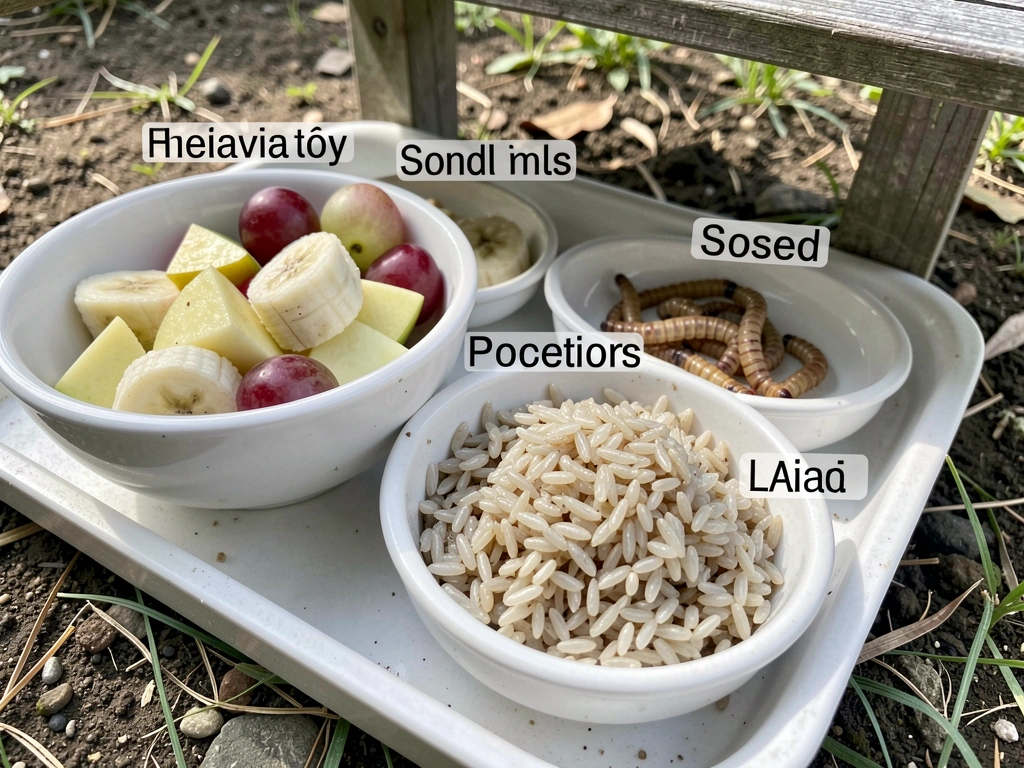
- Soft fruits: mango, papaya, banana, grapes, and apple pieces (no seeds)
- Cooked rice or plain cooked grains (no salt, no seasonings)
- Mealworms, live or dried (excellent protein source)
- Small pieces of cooked meat or scrambled egg (plain, no salt)
- Wet cat or dog food in small amounts (mynas are documented to seek this out in the wild)
- Corn kernels, either fresh or cooked
Wet or moist foods work better than dry ones. Mynas forage mainly on the ground and pick up soft items easily. If you are offering grains, soak them first so they are not a choking risk and are easier for the birds to handle.
What to avoid
- Salt or salty foods (toxic to birds even in small quantities)
- Avocado (contains persin, which is dangerous to most birds)
- Dry bread (low nutrition, choking risk when dry)
- Milk or dairy (birds cannot digest it properly)
- Heavily processed or seasoned human food
- Dry pet kibble unless softened with water first
How much and how often
Start small. Put out enough food to last 20 to 30 minutes of active feeding, roughly two to three tablespoons of mixed items per session. The goal in the first few weeks is to build a routine, not to feed a flock. Once mynas are visiting reliably, you can adjust the quantity to match how many birds are showing up. Offer food at the same time each morning, ideally shortly after sunrise, when mynas are most active and looking for their first meal of the day.
Remove any uneaten food after an hour or two. Leftover food ferments quickly in warm weather, attracts rats, and can make birds sick. Keeping the feeding station clean is one of the most important things you can do for the birds and for your own sanity.
Water, shelter, and nesting materials
Water
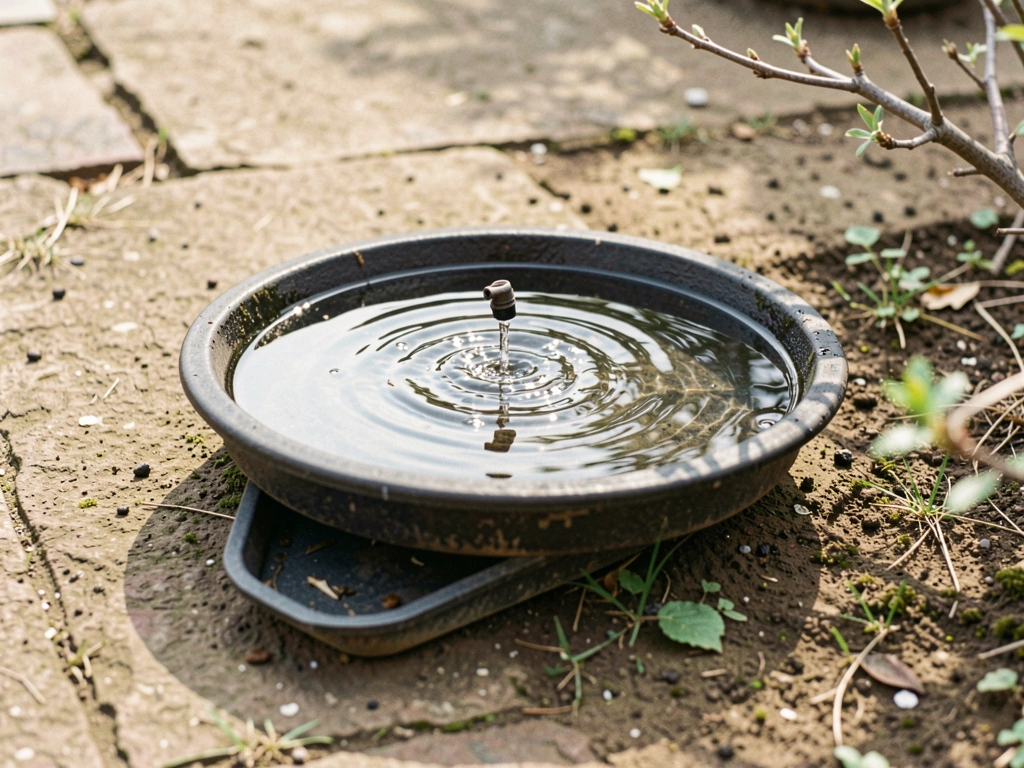
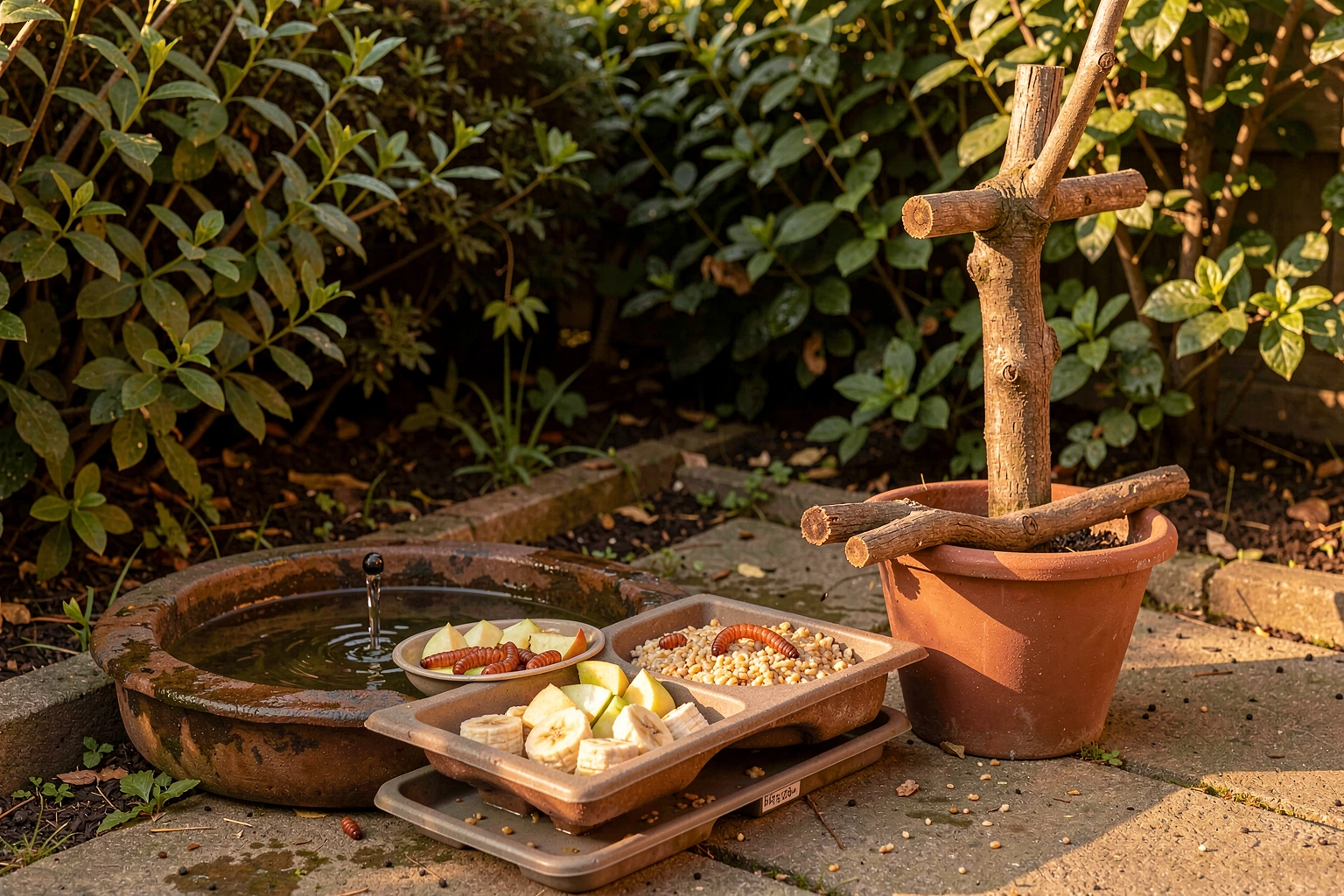
A clean, reliable water source is often more attractive to mynas than food, especially during hot or dry weather. Moving water is even better. Birds find dripping or trickling water very easy to detect from a distance, and mynas are no exception. A basic birdbath with a small drip nozzle or a solar-powered fountain is a straightforward upgrade that makes a real difference.
Keep the water shallow, no more than 5 to 7 centimeters deep. Change it every two to three days to prevent bacterial buildup and stop mosquitoes from laying eggs. If you can manage it, aim to rinse the bath at least twice a week. Mynas, like most birds, will not return to a fouled water source. A container placed directly on the ground also works well and attracts birds that will not use a pedestal bath.
Shelter and perching spots
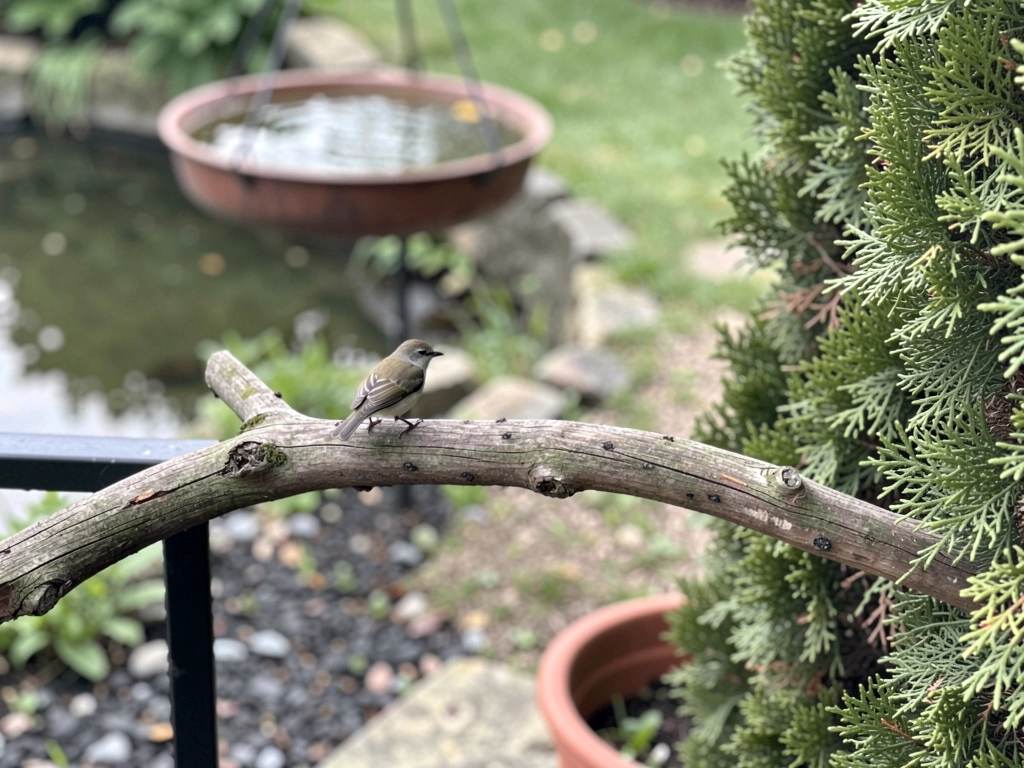
Mynas need nearby perches. They like to land somewhere elevated, assess the area, and then move down to feed or drink. Trees, shrubs, a garden fence, a clothesline, or even a dedicated perching branch stuck into a pot will do the job. The key is that the perch should have a clear line of sight to the food and water, so birds feel safe coming down.
Dense shrubs or hedges near your feeding area also give mynas a place to retreat quickly if something startles them. That sense of security, being able to escape into cover fast, is a big part of what makes a yard feel safe enough to visit regularly.
Nesting boxes and materials
Mynas are cavity nesters and will use a well-sized nesting box. Research on Common Myna nests shows an internal cavity of roughly 14 by 12 centimeters, with a total internal nest length of about 43 centimeters. For a nesting box, aim for an entrance hole of around 5 to 6 centimeters in diameter and an internal cavity depth of at least 25 to 30 centimeters. Mount the box at least 2 to 3 meters off the ground on a wall, fence post, or tree trunk.
Face the entrance away from prevailing winds and strong afternoon sun. Mynas breed in different windows depending on your region, roughly February to May in southern India and April to July further north, so if you are in a region with a similar climate, put the box up well before those windows open. Placing nesting materials like dry grass, small twigs, or strips of bark nearby gives arriving birds an extra incentive to investigate.
Smart placement to guide visits
Because mynas stay close to their roost, your single best move is to figure out where nearby mynas already sleep or nest and place your setup within that 100-meter range. The best time to find a roost is in the 20 minutes either side of sunset, when mynas progressively gather near communal roosts before settling. Watch where they congregate and use that as your anchor point for food and water placement.
Place feeders and water in a spot that is visible from above but feels sheltered at ground level. A corner of the yard with a fence on two sides, for example, gives the bird a clear view while reducing the directions from which a threat could approach. Avoid placing food directly under a tree with a lot of overhead canopy, as cats can use that cover to ambush feeding birds.
Decoys can help in the early stages. A realistic myna decoy or even a printed image placed near the feeding station signals to passing birds that the area is safe. Audio playback of myna calls played softly during the first few days of setup can also draw scouts in. Once real birds start visiting, remove the decoy so it does not create confusion or territorial aggression.
Consistency of placement matters as much as location. Do not move your setup around while you are trying to establish visits. Birds learn by landmarks, and a feeding station that keeps shifting is one they stop looking for.
Handling competition and keeping visits manageable
Mynas are assertive and will compete with other birds. If you are also trying to attract native or more sensitive species, be aware that mynas can displace them from feeders and even from nesting boxes. If protecting native birds is a priority for you, it is worth reading up on broader yard bird attraction strategies alongside this guide.
On the flip side, you may find that sparrows, pigeons, or starlings start competing with your mynas. The simplest way to manage this is to offer food types that mynas prefer but other species are less interested in, like mealworms, fruit pieces, and small amounts of wet protein food. Avoid scattering seeds or grains broadly on the ground, since that attracts pigeons and doves en masse and can quickly make the setup chaotic.
If you are attracting more mynas than you intended, scale back the food quantity rather than stopping suddenly. A gradual reduction keeps the birds from becoming distressed and reduces the chance they will start raiding pet food bowls or neighbors' spaces.
Managing noise, mess, and local rules
Noise
Mynas are loud. Communal roosting in particular produces noisy chattering that can continue after nightfall and start again before dawn. If you are attracting them to a balcony or small garden close to a bedroom window, that is worth thinking about before you commit. Feeding in the morning and removing food by mid-morning means birds associate your space with daytime visits rather than roosting there overnight, which helps keep noise levels reasonable.
Mess
Droppings are the main issue at popular myna feeding sites, and they can accumulate quickly under perches or near feeders. Place a tray or sheet of newspaper beneath your feeding station and swap it out daily. Position feeders away from outdoor furniture or surfaces that are hard to clean. Mynas fed consistently at a dedicated spot tend to concentrate their activity there rather than spreading mess across a wider area.
Local rules and legal considerations
This is the part most people skip, and it can matter. In Australia, the Common Myna (also called the Indian Myna) is classified as an introduced pest species in many jurisdictions, and some local councils actively run control programs to reduce their numbers. The NSW Government, for example, provides official guidance and a control booklet treating mynas as a biosecurity concern. In parts of the United States and other countries, feeding certain introduced bird species may be discouraged or restricted under local wildlife ordinances.
Before you set up a regular feeding station, spend five minutes checking your local council or wildlife authority's website. Search for terms like 'feeding wild birds' or 'Indian myna' plus your city or region. Some areas have no restrictions at all, while others actively ask residents not to supplement myna populations. Knowing where you stand protects you from complaints from neighbors or local authorities, and it helps you make an informed choice about whether attracting mynas is the right call in your specific location.
What to do if they still do not show up
Give it at least two weeks of consistent daily food and water before changing anything. Mynas take time to discover and trust a new source. If you are not seeing any visits after two weeks, work through this checklist:
- Check whether mynas are actually present in your neighborhood. Walk around at sunset and look for communal roosting activity within 200 meters of your home. If there are no local mynas, no setup will bring them in.
- Move your feeding station closer to where you spotted mynas roosting or perching.
- Try a stronger food attractant. Wet dog food or fresh mango are two of the most reliable draw cards based on documented myna preferences.
- Reduce foot traffic and disturbance around the feeding area for the first few weeks. Mynas will not visit a spot that feels unsafe.
- Add a water source with movement. A dripping birdbath is often the thing that finally brings a scouting bird in close enough to notice the food.
- Try playing a short clip of myna calls softly near the setup in the early morning for a few days to attract passing birds' attention.
Once the first myna arrives and feeds without being disturbed, the rest tends to follow on its own timeline. Patience and consistency are the two things that matter most in the early stage. Get those right, and the setup does the rest.
FAQ
Can I change the food mix after mynas start visiting, or do I need to keep it exactly the same?
Yes, but do it gradually and keep the station predictable. Start by adding only a small amount of the new food type to your usual mix for 3 to 4 days, then increase if birds keep coming. If you swap suddenly to something unfamiliar, you can break the routine before scouts fully commit.
What’s the best water setup if mynas ignore my birdbath?
For ground-feeding species like mynas, a shallow catch is usually better than a pedestal. Use a container placed directly on the ground (or a very low base), with clean water and a slight slope so footing is stable. Place it near your perching zone so birds can hop down safely to drink.
Why do mynas sometimes stop coming after I add fruit or food scraps?
Avoid leaving fruit or wet scraps uncovered for long stretches. If you use softer foods, offer them in small portions during your normal morning window, then remove leftovers within 1 to 2 hours, and rinse the bowl or tray. This reduces fermentation smell that can repel birds and attract pests.
I set up food and water, but no mynas are showing up. What should I troubleshoot first?
If you are not seeing visits, first verify there is a nearby roosting or nesting site within roughly 100 meters, since mynas often do not forage far. Next, check placement, keep food and water at the same time each morning, and ensure you have a clear line of sight from the perch to the station (so birds feel safe to approach).
How can I prevent other birds from taking over the feeding area without losing myna visits?
Use short-term, human-safe deterrents that do not destroy the routine. Remove attractive distractions like open pet food or unmanaged garbage, and keep your feeding station clean. If your goal is to attract mynas only, do not scatter grains broadly, because that draws other species that can interfere with myna visits.
When should I install a myna nesting box, and how can I increase the odds it gets used?
Seasonal timing matters. If breeding is about to start in your region, place the nesting box well before the local breeding window and mount it in a sheltered spot with minimal strong afternoon sun. Also ensure the entrance is not directly exposed to prevailing winds, which can reduce occupancy even if the box size is correct.
What’s the safest way to reduce myna activity if they become too many for my space?
If you want to avoid luring more birds than you intended, reduce the portion size while keeping timing and location consistent. A good approach is to cut back incrementally over several days rather than stopping, since abrupt changes can cause birds to look for food elsewhere quickly.
Do decoys or myna call audio actually work long-term, or should I stop them after scouts arrive?
You can, but keep it in the same location and do not run it all day. Use it briefly during the first few days to attract scouts at low volume, then remove it after real birds start visiting so you do not trigger confusion or territorial behavior among incoming mynas.
How do I manage droppings and keep the area usable without constantly moving the station?
They can, especially if feeding sites become muddy or heavily soiled. Put a disposable tray or newspaper under the station, change it daily, and keep the feeder far from outdoor furniture and hard-to-clean surfaces. If droppings are accumulating in a specific corner, shift the station slightly but keep it within the same general landmark area so birds still find it.
What can I do about cats while trying to attract mynas safely?
Often, yes. If you have feral or roaming cats nearby, place feeders and water in a corner with fencing on multiple sides to reduce approach angles, and avoid placing food directly under dense canopy where cats can ambush. Also choose a perch with clear sightlines so birds can detect threats sooner.
Next Article
How to Attract a Baltimore Oriole Bird to Your Yard
Step by step tips to attract Baltimore orioles with nectar, fruit feeders, proper placement, yard habitat, and troublesh